 |
| Print vs. Digital--Independent and Used Bookstores |
Saturday, December 6, 2014
Print Book-Lover Poster for my Publishing Class Project

Saturday, November 15, 2014
The Merritt Parkway: The Road That Shaped A Region by Laurie Heiss and Jill Smyth

We all remember griffins from Harry Potter, but did you know
you can see them when you’re driving on the Merritt Parkway? Those and more esoteric designs, such as Nike
Wings (not the sneaker!), to the more everyday butterflies and spider webs,
grace the bridges and overpasses along the 37.5 mile roadway. Adding to the beauty of your drive are the aesthetically
pleasing landscapes of the median strip. The parkway, which runs through
Fairfield County, was largely responsible for the County’s prosperity and
population growth in the 20th century. In fact, “…it was the opening of the parkway
that helped precipitate the hegira to Fairfield County”. Built to relieve highway congestion in New
York and Connecticut, it became an alternate route to the Post Road and
accommodated recreational driving, known as the “Sunday drive”. The cars only, no trucks policy adds to the
bucolic aura.
Heiss and Smyth divide the book, published on October 21, by
decade, spanning from the 1920s to the 2010s.
They add a touch of flare by subtitling each chapter with the most
popular car of the decade and a song that would have played on the car radio at
the time. For the 2000s, it’s the Toyota Prius Hybrid and “Empire State of
Mind” by JZ and Alicia Keyes. Today,
most young people see it as just a highway, but it was extremely important to
the generations of the past because of “a needed job, a delightful escape, fall
colors and spring blossoms, a Sunday family tradition, access to home ownership
further from a job location, the joy of the golden age of the automobile, [and]
a new love affair with the road”. The
opening of the Merritt parkway, therefore, had a major impact on the lives of
Fairfield County residents who grew to appreciate its convenience. Over the years they have sought to protect
its integrity and preserve its special qualities for future generations.
The famous bridges of the parkway (all 72) were designed by
artist and architect, George Dunkelberger.
He took into account the natural surroundings before individualizing the
architectural designs of each bridge per road.
The designs range from art deco
to rustic stone-face to late gothic revival and more. The Merritt comprises “a precious collection
of diversely styled bridges with a touch of whimsy”. Next time you find yourself in a traffic slow
down on the parkway, take a longer look at one of these famed architectural
masterpieces remembering the timeless significance of “the road that shaped a
region”.
Interview with Laurie Heiss and Jill Smyth:
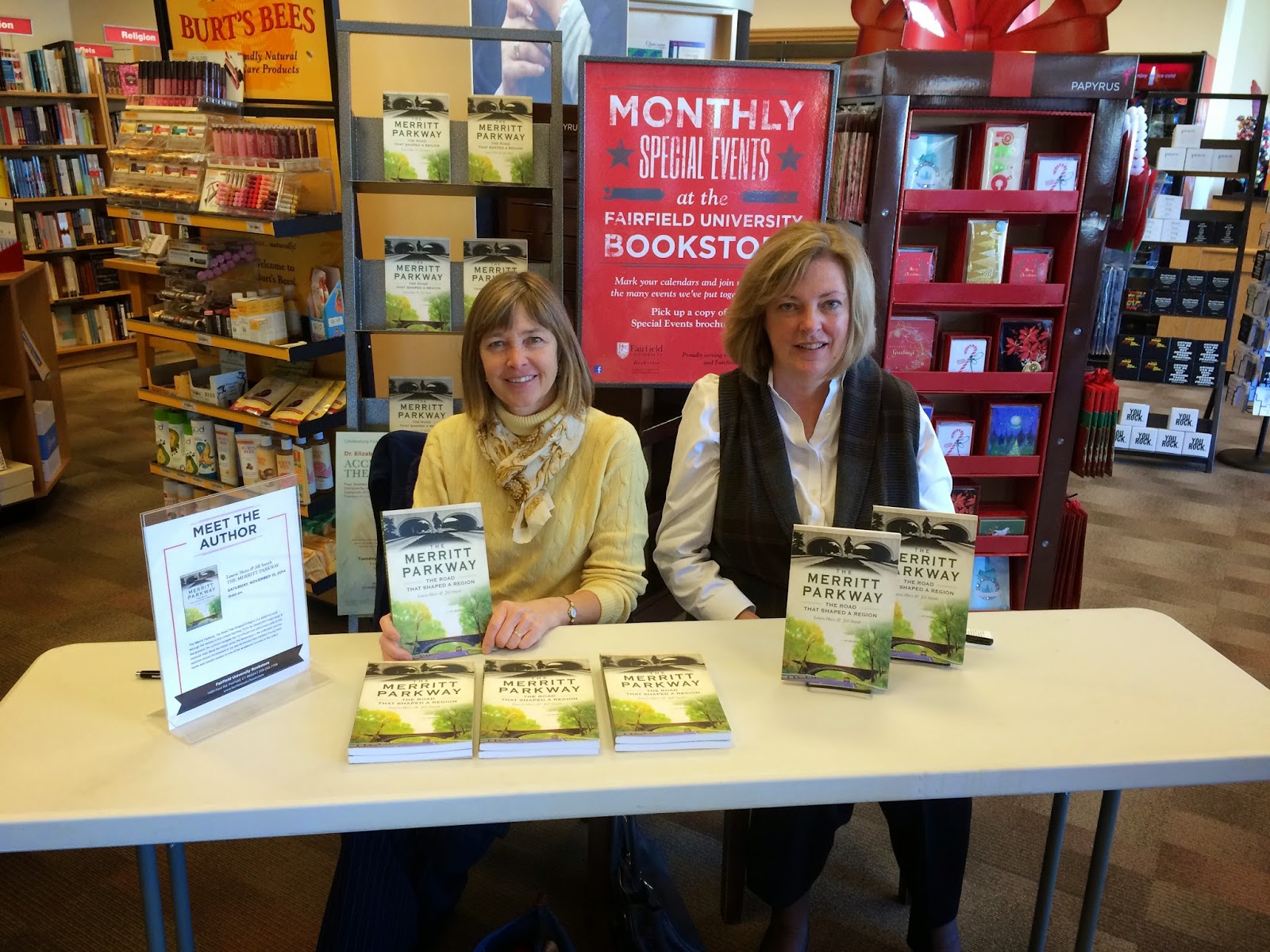
1) Understanding your involvement in the Merritt Parkway
Conservancy, what inspired you both to compile a book about the history behind
the Merritt Parkway?
We were actually pursued by the History Press, the publisher
for The Merritt Parkway. I (Jill) was approached and realized I didn’t
want to take on the project on my own so I went to Laurie with the idea. The other Parkway books on the market are
mostly out of print or outdated and predominantly books of photographs. We also felt publishing this now was a result
of good timing since the Merritt’s 75th Anniversary is next year.
2) What is your favorite aspect of the parkway?
There are certain bridges that I (Laurie) adore and I also
enjoy the intimacy of the roadside, more specifically the framing of the road
and the landscaping. I (Jill) would say
the most important and interesting aspect of the parkway is its influence on
Fairfield County. When the Merritt first
opened it was a form of entertainment for drivers and it’s wonderful that we’re
still able to experience the parkway in much of the same way!
3) Is this your first writing project? Do either of you have
anything planned for the future?
This is our first book both individually and jointly, however,
I (Laurie) wrote segments of different business books and worked on an internal
book for GE. I enjoy writing whereas
Jill prefers the research portion of preparing a book. However, this book was
written and researched equally by both of us because we believe it is crucial
to write from your own research. We
don’t have anything planned yet in terms of another book.
4) What was the hardest thing about writing this and
obtaining such wonderful photographs to accompany the book?
The outline was probably the hardest part of the process along
with the anxiety about overlooking anything in our research. Sometimes we would know a bit of information
in the book was wrong that the editor had missed, but since they were on a tight
schedule it would still go to print. We
discovered the book distribution process to be very slow as well. Our main difficulties included everything
from fact checking information to verifying sources to working with editors on
a schedule to merging and sorting photographs into their correct placements
including their captions. Obtaining
high-resolution photographs was problematic because many of the pictures were
so old or because taking a picture of something with our phones did not have a
high enough image quality. Therefore,
there were technological challenges as well.
It seemed backwards to us that the photographs were due before the text
in editorial; it would have been easier to fit the pictures in afterwards. Regarding research and ability to obtain
sources, we were actually able to acquire a lot of primary sources from Buzz
Merritt, whose great uncle was the namesake of the Merritt Parkway. He provided folders of papers and letters
from the advisory meetings of the ‘80s.
5) Your book is divided by decade. Which do you think was most influential in
the growth and survival of the parkway?
The 1930s was the decade in which the Merritt was built,
however, the activism of the 1970s was also highly influential. Additionally, the 1920s was the decade in
which people fought for a vision, an image in their minds, to create something
beautiful out of the New York and Connecticut countryside. At this point in time the project had not
even been financed yet! There were
immense hurdles throughout the ‘20s. The
actual construction of the parkway happened relatively fast, but the plan and
design of it all took ten years. So they
had to keep the pressure on for about ten years from the mid ‘20s to about
1934.
6) What advice would you give researchers and writers?
Every time you read something for later use, write it
down. Put all your information in the
same place and fully document your sources.
If you take a picture with your phone of crucial information, write a
log of your sources. The key is
organization and documentation.
Wednesday, October 29, 2014
Signed, Sealed, Delivered: Celebrating the Joys of Letter Writing by Nina Sankovitch

Author Sankovitch sets out to understand the spirit and potency of
long forgotten stories bound up in letters. There is a certain power in
letters that is absent within the boundaries of text messages and
e-mails. Holding a tangible object in your hand connects you to the
sender through the aroma of the paper and ink and through their particular,
quirky handwriting. Upon reading the book, perhaps you, too, will
recognize the benefits of letter writing by taking up pen and paper to connect
to someone on a whole new level. Nina Sankovitch reminds us “…there is
more than enough happiness in the world, isn’t there; we just have to
acknowledge it. And what better way than through a letter”.
Interview with Nina Sankovitch:
1) What initiated your interest in writing?
I have always been interested in
writing, but even more interested in reading! During my year of reading a
book a day, I wrote every single day - I wrote a review of the book I'd read
the day before. I wanted to share what I had learned from the book or liked
about or what I didn't like about it with readers of my blog, www.readallday.org.
2) Have you ever though of writing a novel?
My blog originally began as a way to
encourage reading by adults for pleasure, and its motto was "Great good
comes from reading great books." For me, that turned out to be true
in so many ways. I learned to live with my sorrow over the death of my sister,
and how to carry her with me always, and live in joy, appreciating the small
and big moments of life - and always enjoying moments spent reading! I
also wrote my first book about my year of reading and what I learned - Tolstoy
& the Purple Chair - and was able to continue writing books, with my
third one due to come out in 2016.
3) If you could choose one of the letters you have
found/read, which would be your favorite and why?
My favorite letters are the
ones written by my children and my husband. Through the kids’ cards and
letters, I can keep them young beside me - even as they grow up. And my
husband's letters are both very funny and very loving - perfect for making me
feel better when I read them over again. But my favorite letter that I
found? I have so many - but I do love the letters of James Seligman, because he
started me down the path of looking at the entire history of letter writing. He
was so funny: "Your letter and your check couldn't have possibly been more
welcome...If you send a check with every letter, write as often as you want,
twice a day if necessary."
4) Could you talk a little about your next upcoming writing
project?
My next book is about The
Lowells of Massachusetts, from the 1600s through the 1900s - they were a
fascinating, dynamic family, of Puritan origins and then great patriots during the
Revolution, and then becoming a leading family of the Boston Brahmin. Their
story is the history of New England, both in terms of crises and
successes, and offers a unique twist on the American dream.
5) Who are some of your favorite authors?
My favorite authors are Nadine
Gordimer, Wilkie Collins, Charles Dickens, Louise Penny, Haruki Murakami, Anne
Cleves ... to mention just a few.
6) Finally, what advice would you give aspiring writers?
The best advice I can give aspiring
writers is to write every day, every single day. Don't wait for inspiration,
set goals and meet them. WRITE EVERYDAY - you won't keep it all but it is all
good practice. And READ every day, if you want to write well - you learn so
much just about writing by reading lots of different types of books.
Thursday, October 23, 2014
The Love Song of J. Alfred Prufrock: A Modern Reimagining by Sarah Daltry

Perfect for readers on the go, this short but sweet novella is
an independently published modern take on T.S. Eliot’s famous poem, The Love Song of J. Alfred Prufrock. Told in flashbacks and present day scenes,
Daltry weaves a modern summer beachside romance between two young lovers. Echoing the original poem, she expresses lonely,
desperate themes as seen here: “For eighteen years, summer was our chance to
find the key, and every fall brought disappointment, when we ended up back at
school with no new stories and we were the same people we’d been three months
earlier”. The character of Eliot’s narrator
is reimagined in Daltry’s short piece as she traces his life from a hopeful
past to a disillusioned present. Told in
the first person narrative, main character Jake meets Emily, a beach town
resident at a general store where he works.
Their romance quickly follows and hastens its pace through the summer
months. As autumn approaches, the two
begin to question what will become of their love and struggle to make every
attempt for a lasting affair. As the
cruel hands of fate sweep in they provide an unexpected close to the short
novel. This accessible modern
interpretation of such a widely read poem is a perfect bridge between readers
of novels and readers of poems. Grab
yourself a latte and this book and see if you agree with Eliot that “in a
minute there is time for decisions and revisions which a minute will reverse”.
Interview with Sarah Daltry:
1) What inspired you to begin writing?
I made up stories my entire life. My parents worked a lot and we didn’t have a
lot of money. I was always reading,
spending many days in the library. Writing
always came natural to me.
2) How did you come to choose T.S. Eliot’s poem “The Love
Song of J. Alfred Prufrock” to write your novella?
I taught high school English. I love classic literature. I started working on this piece, which took me
almost two years to write. I’ve always
loved that whole time period. For
example, when the movie “Midnight in Paris” came out I fell in love with the
setting and time. I was never a fan of
Hemingway until I read The Sun Also Rises. I loved teaching authors such as Fitzgerald,
Hemingway, and Eliot. I was inspired to
think about nostalgia and really loved Eliot’s poem. There were so many interpretations to be made
with unspoken pieces that were relevant to any decade.
3) Do you feel that you relate to either of the main
characters in your story?
I relate to the man a bit but he is older than me. I used personal observations in reimagining
the poem. I don’t live in New York City
but I have lived in New England my whole life so I tried to use a city I was
familiar with. I thought, how could I
take these observations and make it into a story. It was an experiment.
4) Can you talk a little about independent publishing, what
made you decide to go this route, and the difficulty level?
I’ve been writing for a long time. I have a lot of novels and many half written
pieces. Fifteen years ago I wanted to be
a writer. I tried the traditional
publishing route and got rejected many times, so I only ended up publishing a
couple short stories here or there. I
liked teaching and thought I would go after writing someday. A few years ago my grandfather died and I was
talking to my grandmother about writing.
I realized my aunt, who’s in her 60’s now never acted on her talent for
writing. I had all these ideas for
writing but knew that I would never actually do anything unless I started
writing seriously. My first novel was a
vampire romance based on biblical themes and was published through an imprint
of Harlequin. I decided to work on young
adult fiction, specifically a college story.
It turned into a sexy romance because of the stigma that ‘sex
sells’. It worked for self-publishing
and took off for a little but I knew I didn’t want this. I wrote Backward
Compatible and tried to go traditional with that, but I was told there
would be no market for it. I realized,
however, that this is what I wanted to be writing. I was making the choice to write what I want
not to write what’s marketable. I am not
a big advocate for either self-publishing or the traditional route, however, I
would rather sell 20 copies and be on a shelf somewhere than sell millions
writing about something I don’t care about.
I’m willing to work really hard but would like someone to filter
it. I would prefer the traditional route
but appreciate the self-publishing route, which gives opportunity.
5) What are you reading now and who are some of your
favorite authors?
Right now I am reading The
Lord of the Rings: The Two Towers. I
finished The Lord of the Rings: The
Fellowship of the Ring this summer.
Also on my list is the third novel in the Anna and the French Kiss series, Isla and the Happily Ever After by Stephanie Perkins and Dreams of Gods and Monsters by Laini
Taylor. My favorite classical authors
are Hemingway, the Bronte’s, and Salinger.
My favorite more contemporary authors include Courtney Summers, Lauren
DeStefano, Jodi Picoult, and Tom Perrotta.
I like to read realistic contemporary and young adult fiction. A lot of adult fiction tends to have a
certain focus, genre or literary.
Sometimes I just want to read a story that isn’t genre, just realistic,
but also not trying too hard to be literary.
6) What advice would you give to aspiring authors?
You need to know what your goal is. You need to write the story that matters to
you. Ask yourself, do you want to be a
storyteller or a businessperson? Why are
you writing it? It took me a while to
follow my own advice, but I’m happier now writing a book I’m happy with. Your first question you should ask yourself
is why are you writing?
The Truth About the Harry Quebert Affair by Joel Dicker

In the summer of 1975 in the small, seaside town of Somerset, N.H., 15-year-old Nola Kellergan vanishes without a trace. Her story doesn’t pick up again until 2008, the year in which the novel is set. Enter Marcus Goldman, a successful writer living in New York City who is desperately searching for his next big bestseller, a second novel that will supersede his outrageously popular first novel. Faced with the doom of writer’s block and his editor’s impending manuscript due date, Marcus flees to his mentor and former professor, Harry Quebert.
Soon after his arrival, Nola’s body is found on Harry’s property buried with a very compelling item, one that will throw a shadow of guilt on Harry. Has Harry had an affair with the girl? Did he murder Nola? It doesn’t look good for Harry, so believing he owes his career and happiness to his mentor, Marcus sets out on a search of his own in the hope of proving Harry’s innocence.
As the situation becomes more and more miserable for Harry, one in which his life and reputation hang in the balance, Marcus develops an agenda of his own. He begins to use his research and resulting story to spark a new novel, the great novel that will continue to enhance his fame and popularity as a modern author. He cares about Harry, but does he care more about his own career? Plagued by death threats from unknown sources, and pressure from his editor, Marcus races to discover “The Truth about the Harry Quebert Affair.”
The writing is so seamless and flowing, you wouldn’t ever be able to tell it was translated from French. This book will sweep you under like the waves relentlessly hitting the shore in Somerset. When you finally come up for air, the amazing denouement will take your breath away again.
Death Logs In by E.J. Simon

For us readers in Connecticut, the settings of Westport and New York City are recognizable and comfortable, but we are then swept up into over-the -pond locations such as Paris, Rome, and Venice. This exciting international sci-fi thriller may hop around between places and events, but the author deftly spins a spider web of connections that keeps you anticipating the next chapter.
Michael’s brother Alex, who was murdered in “Death Never Sleeps,” is now back as a virtual character. His mind was uploaded onto an Apple Mac computer using highly advanced programs found within the walls of Michael’s wine cellar. The system works to preserve the emotional and technical aspects of a human mind within the confines of a computer. Many are in disbelief of this modern phenomenon, so Michael tells very few people, and mistakenly confides in his wife Samantha.
The multilayer plot includes futuristic elements, but also deals with Michael’s new every day life as CEO of Gibraltar, a Fortune 500 company, and as CEO of Alex’ s company, Tartarus, one of the world’s largest illegal gambling operations. Once a straight corporate man, Michael appears to have absorbed Alex’s persona in his sudden affinity and ability for treacherous, organized crime. This business has new requirements, including the need for a bodyguard in the form of the stunning, yet toxic, Sindy Steele. Loyalties will be tested as the stakes reach a crescendo of unlikely twists that will leave you astounded, on the edge of your seat and eager for Simon’s next installment, “Death Logs Out,” which is coming soon.
Interview with author, E.J. Simon:

First, knowing your background in the corporate world, what motivated and interested you in writing?
I enjoyed my college writing, but abandoned it to earn a living in business. It’s a pretty typical scenario. I have always been an avid reader, however, and I think it’s been the constant reading that actually inspired me to write. Some of that reading – Stuart Woods’ novels, for instance, are not necessarily the finest “literature” but very entertaining. By the way, I’m not trying to be Tolstoy or Hemingway myself – my goal is to write great, entertaining commercial fiction.
Briefly where did you get the inspiration for “Death Logs In?”
“Death Logs In” is the follow up novel to “Death Never Sleeps” – it’s a free-standing sequel. The inspiration for both books came from two of my favorite movies: “The Godfather” and “2001 Space Odyssey.”
I loved the treatment of the family relationships and the realistic depiction of mob violence in “The Godfather.” The idea to add the aspect of artificial intelligence into my story came from “2001 Space Odyssey.” In that movie, the computer onboard the spaceship, named Hal, refuses the astronaut’s command to disconnect itself and, in fact, takes over the space craft.
Do you believe artificial intelligence, specifically what is keeping Alex “alive,” is a thing of the near future?
Yes, artificial intelligence is already at work all around us. It’s still in the early stages but, for example, “Watson” the computer defeated the best human contestants on Jeopardy already, not to mention Siri on the iPhone. I also believe that governments are using it to predict behavior in ways we can only imagine. You should also check out the Westport Library where they have two robots, Vincent and Nancy, to help teach coding and computer programming skills. They can recognize faces, respond to verbal commands and carry on conversations. Scientist Stephen Hawking and Apple Co-Founder Steve Wozniak, both have been quoted recently stating that soon computers will have a consciousness.
What was the hardest part about writing this?
Wondering if anyone was going to read it. Writing a novel is a long project, beginning with the idea, the concept, the actual writing, then editing, the creation of the actual book, getting it published and then the whole marketing effort necessary to be sure that it gets onto Amazon and into bookstores. Finally, there is the publicity work necessary to ensure that people actually purchase it.
Today, writing a novel is more like starting up a business. The book is simply the product and the beginning of the process.
Will the two novels continue into a longer series?
Yes. I’m working on the third novel in the series, it’s titled “Death Logs Out.” Alex’s artificial intelligence software is learning, as it was designed to do, and so he’s becoming more powerful.
On a more personal level, which authors do you feel have been your mentors over the years?
I’m not sure about mentors, but the authors who have influenced me to become a writer are James Patterson (not so much for his most recent writing but for his ability to capitalize on his writing, turning it into a huge commercial success) and Stuart Woods, (I love his “Stone Barrington” series; he makes it appear so effortless but, I know, it takes hard work to make anything appear to be easy). Dan Silva and Dan Brown are also my favorites, I admire their stories and their writing.
Do you have plans for other upcoming writing projects?
Yes, I’m co-authoring a true crime book with Vito Collucci, Jr., a Stamford, Conn. detective who went undercover for the FBI to uncover corruption in the Stamford police department. The book will also go into the “Bra Murders,” which occurred in Stamford, and Vito’s investigative work on behalf of Robert F. Kennedy’s nephew, Michael Skakel, in the Greenwich murder of Martha Moxley.
What advice would you give aspiring writers?
Read a lot, write a lot, take some writing course in the genre that you want to write and never give up. I’d also recommend Stephen King’s book, “On Writing.” I like it even better than his novels.
E.J. Simon’s book “Death Logs In” and many others can be found for sale on his website here. Use the promo code “stags” for 20 percent off your purchase.
Wednesday, April 2, 2014
A Changing Marriage by Susan Kietzman and Interview with the Author

For college kids
like us, caught up in hook ups and one-night stands, marriage probably isn’t
something at the forefront of our minds.
This predictable though true to life book may either bore you to tears
or open your eyes to how your choices now have the power to affect your future
happiness. A Changing Marriage by Susan Kietzman is a love story between two
people who met in college, and married quickly thereafter. After having children, their marriage quickly
spirals into sarcastic bickering and resentment. The opening of the novel accurately captures
college life and later deals with the hardships of choosing between two men and
the constant consideration whether life would have been better had she chosen
differently. The mid section of the book
describes main character Karen’s daily life in intimate diary-like detail. It is quickly obvious to the reader that
Karen and her husband Bob’s marriage is not a happy one and their equally
selfish demeanors begin to overshadow their love for each other. Once Bob’s life becomes consumed with work
and the next promotion and the children are old enough to attend school, Karen
uses her newfound freedom to join a ladies tennis group and to lunch and shop
with her wealthy girlfriends. She
becomes enveloped in her new life in which she flaunts her ability to do what
she wants. While motherhood is
undoubtedly strenuous and Bob’s continual absence on business trips frustrating,
Karen becomes enveloped in the rich socialite scene and begins to lose her
pride and motivation. Her good friend
Sarah, whom she met at the playground when the children were younger, helps her
come to the realization that she might want more from life. In the last third of the book an interesting
plot begins to take shape and changes Karen’s repetitive lifestyle for the
better. While the ending is somewhat
unsurprising, lessons are learned and the author’s purpose is clear that a
marriage or a relationship for that matter is a two way street and thrives on
listening to one another, caring, understand, and compromise. Though Kietzman’s book is overly detailed at
times, the general theme and message of the book is essential for anyone
looking to forge a long lasting relationship.
Though most people have heard what it takes to make a marriage work, it
is valuable to have the opportunity to take a first hand look at the ups and downs
of day to day matrimonial life and the consequences of a failed marriage. Published just last month, A Changing Marriage full of themes like
love at first sight, temptation, self-absorption, and the ever-present life
question, “what if?” presents a thoroughly honest look at married life.
An Interview with the author, Susan
Kietzman:
1) Where
did you get the inspiration for A Changing Marriage and do you have
personal experience with this type of married life?
The
inspiration for this book came out of conversations with friends and acquaintances,
especially those who were home with children. Some will think it’s
autobiographical because I’ve been married for 28 years and have three children
I stayed home to raise. The emotions Karen is feeling – of being unappreciated,
of missing more intellectual pursuits, of envy that her spouse can live the
same life with children as he lived before them – will ring true, I think, with
many women. And Bob’s rise to power in the business world will resonate with
men and women alike.
2) Are
Karen and Bob completely fictional characters or are they taken from people in
your own life?
This is a question I get asked a lot. Because I am the author, people assume
that I’ve drawn from my own experience to write the book. They next assume,
therefore, that the book is either 1) about me, or 2) about people I know. And
while I certainly do draw from my experience, I don’t write consciously about
friends and family. My characters and storylines come from a number of sources
in addition to my life experience: what I observe in others, what I read, what
I see on television or at the movies or by simply going about my daily tasks,
conversations, what I imagine might happen in one situation or another, etc.
Fiction has to be viable and sound true to the reader or it doesn’t work.
3) I
found the ending to spark a possible new beginning between Bob and Karen,
especially in the deli scene when Bob remembers back to the first time he saw
Karen in their school's student center.
Would there be a possible sequel in the works? Do you think the two will try to rekindle their marriage despite their both already being married for a second time?
I don’t have a sequel to A Changing Marriage – or to my first novel, The
Good Life – planned. But this doesn’t mean it won’t happen! It’s hard to say what
Bob and Karen will do. I purposely left the ending of the book open, so the
reader could decide for her/himself. Life can be messy and unpredictable, so it
seems to me that believable fiction should be the same.Would there be a possible sequel in the works? Do you think the two will try to rekindle their marriage despite their both already being married for a second time?
4) If
no sequel, could you tell me a little bit about your next project?
I have another
two-book contract with Kensington, so I am now working on my third novel. It’s
a family story that takes place at a shoreline cottage over the course of two
summers thirty years apart. It’s scheduled for release spring/summer 2015.
5) Which
authors have you felt have been your mentors over the years?
I belong to a book group at my local library, and we read a wide variety of
authors. When I was in college, most of the authors I admired were men. And now
they are women: Elizabeth Strout, Barbara Kingsolver, Carol Shields, Ann
Patchett – although I’ve read two books in the past year by Denis Johnson,
whose stories are off-beat with hard-to-like but memorable characters.
6) What
are you reading now?
I’m finishing Johnson’s Angels and reading poetry by Norah Pollard, who
lives locally. Next on the book group list is The Painted Drum by Louise
Erdrich.
7) Finally,
what advice would you give aspiring writers like me?
Take it seriously and write every day – if you make it a priority in your
life, it will take you wherever you want to go.
Subscribe to:
Posts (Atom)